Random Thoughts of a Catholic Husband, Father, Physician, Licensed Commercial Septic System Operator, Driving Instructor, Tractor Mechanic, Gardener, Deliverer of All Foods Carry-out, Amateur Book Reviewer, Neo-Texan, Novice Chicken Rancher, Beekeeper, and Writer of Really, Really Bad Poetry. I try to live up to Chesterton's observation that 'a thing worth doing is worth doing badly.'
There may be spoilers in this review. You have been warned....
For Greater Glory is a movie about the Cristero movement which arose in response to the Mexican government's crackdown on the Catholic Church. This occurred in the 1920's, and gave the Church many martyrs to the Faith, such as Blessed Miguel Augustin Pro.
This movie features several characters who were involved in the struggle against repression of the Catholic Church. It seems providential that this movie shows up at the same time our own government is mandating that the Catholic Church participate in things which are against our core beliefs. I also found a line from the movie amusing - you can see it in the trailer above - where the General tells Jose that 'I never had a son, but if I did, I would want him to be just like you.'
That line reminded me of the quote from our fearless leader:
"If I had a son, he would look like Trayvon Martin."
Which reminded me of this picture and quote:
But back to the movie. The movie is 'R' rated because of a lot, a WHOLE LOT of violence. Granted, a lot of people get shot and stabbed in the movie, but at least one doesn't see intestines and other viscera go splat all over the place. We are spared a close look at some of the more gruesome and disturbing things which happen in the movie.
We went to the movie after instructing two of our oldest children that we would leave if there were any nude scenes. Thankfully there were not any scenes, but we spent the whole movie anticipating them. There was one very brief scene where we see some young women smuggling bullets by placing them in cloth wrapped around their middles, but the camera did not spend a long time lingering on this subject. Compared to a couple of movies from the 1950's, where a lot of women dance around in their undergarments (think dance scenes in Seven Brides for Seven Brothers, and Oklahoma), For Greater Glory is rather tame.
There is another scene where a married couple are in bed - modestly dressed - and kiss each other. That is as far as the scene goes, without implying anything followed that rather chaste kiss.
One of the best scenes in the movie had to be where a priest refuses to give Holy Communion to a character who had been away from the Church for years. The priest insisted that he must go to Confession first, even after the man points out that God already knows his sin. It was great to see proper respect for Our Lord in the Blessed Sacrament in a movie.
There were times I had to remind myself that I was just watching a movie. Even so, I found it very hard to watch a child suffer and die. For me, such scenes bring to mind things which have happened in my own life.
The actors were all good, with no stereotype 'saintly' Cristeros or nasty government folks. I was kind of surprised that Andy Garcia has gotten oooooold. I recall he was in the movie 'Stand and Deliver' twenty five years ago.
I would watch this movie again, and I would recommend it for older teenagers and up. This is not a movie for the little children, as the body count is enormously high and there are many tense moments throughout. Like so many other movies, I left the theater wanting to learn more about the history of the Cristero movement.
One last thought: if you stay to watch all of the credits, pay close attention to one which mentions tobacco products. I kidded with Carolyn that they should have added that 'no cigar was wasted in the making of this movie.'
Annunciation Catholic Church in Houston, Texas. The scaffolding covers the steeple, which is undergoing some needed repairs.
I Wandered Lonely as a Cloud, by William Wordsworth
I WANDERED lonely as a cloud
That floats on high o'er vales and hills,
When all at once I saw a crowd,
A host, of golden daffodils;
Beside the lake, beneath the trees,
Fluttering and dancing in the breeze.

Continuous as the stars that shine
And twinkle on the milky way,
They stretched in never-ending line
Along the margin of a bay:                                  10
Ten thousand saw I at a glance,
Tossing their heads in sprightly dance.

The waves beside them danced; but they
Out-did the sparkling waves in glee:
A poet could not but be gay,
In such a jocund company:
I gazed--and gazed--but little thought
What wealth the show to me had brought:

For oft, when on my couch I lie
In vacant or in pensive mood,                               20
They flash upon that inward eye
Which is the bliss of solitude;
And then my heart with pleasure fills,
And dances with the daffodils.
                                                              1804.
It is Summer time in Texas. Well, let me qualify that. For most Texans, Summer starts when school ends. But for us Homeschool types, school never ends. I actually think that doing school throughout the Summer, sitting in the air conditioning is a good thing for our children. Let them go out in the morning or the evening, when the temperatures are milder.
The poem above is one of those things which one of the Noisykids has to analyze today. I figured that I could review it on the blog, since I had to read the poem, read my son's analysis of it, and then critique his writing. It is all good, since the way to become a writer is to write, and to review other people's writing. It goes along with this quote, which really struck me:
"Fifteen years from now, after you have mastered your craft, you
will yearn to return to the things that most fascinated you when you
were undergraduates."
- Anonymous Law School Professor
Yep. Carolyn has never asked me to whisper medical facts in her ear when she is feeling romantic. Seriously, though, I really enjoyed the few literature classes I took, and consider reading and writing to be a great avocation.
First, let us look at the anatomy of the poem:
1. Twenty-four lines, broken into four stanzas.
2. Each line consists of 8 syllables. There are a couple of lines where there are actually 9 syllables, but one could slur the words to make it more like 8 syllables. Look at lines 6 and 7. If one skipped the second syllable in 'fluttering' and pronounced it 'flut-RING,' or pronounced 'continuous' as 'contin-yoose,' the 8-syllable rule is observed.
          Fluttering and dancing in the breeze.

          Continuous as the stars that shine
I have a thing for syllables, because I like writing Haiku poems,
and there one has to watch that the syllables don't go over the limit.
3. The rhyme pattern is A-B-A-B-C-C, where the first line of each stanza rhymes with the third, and the second and fourth rhyme with each other. The final two lines in each stanza form a separate couplet. There are no rhymes which connect any of the stanzas.
4. The only symmetry in the poem is that the poet starts out by looking at the daffodils, and ends up recalling the pleasure that came with seeing the flowers.
So, What does the poem say?
In the first stanza, the poet discovers a field full of daffodils. The title and first line of the poem imply that the writer was sad and feeling very lonely when he encountered the flowers. In the next two stanzas, he describes the flowers as numerous as the stars in the sky, and as dancers on the shore of the lake. He ends the third stanza by commenting that he did not appreciate just how much gladness came from seeing the daffodils. In the fourth stanza, he writes how his memory of the daffodils fills his heart with joy and consolation when he is sad.
By the way, for those of you who wondered, jocund means cheerful, merry, glad. Try to use it in a sentence today.
What does this poem mean to me?
This poem reflects my own experience, which automatically makes it a good poem. All of us have past experiences which we recall with joy. In Wordsworth's poem, he saw a field of daffodils alongside a lake. For me, there are many memories which can bring back such happiness that they may brighten any difficult or sad time. All of us have pleasant memories which can bring a smile to our face, even those which seemed trivial at the time. William Wordsworth has shared this thought with us in just a few lines of simple poetry.
I started putting some poems appropriate for Memorial Day on facebook, but then I figured it would be better to just put them all on here and link it to facebook. So, here goes....
Prayer of a Soldier in France
Alfred Joyce Kilmer (1918)
My shoulders ache beneath my pack (Lie easier, Cross, upon His back). I march with feet that burn and smart (Tread, Holy Feet, upon my heart).
Men shout at me who may not speak (They scourged Thy back and smote Thy cheek).
I may not lift a hand to clear My eyes of salty drops that sear.
(Then shall my fickle soul forget Thy Agony of Bloody Sweat?)
My rifle hand is stiff and numb (From Thy pierced palm red rivers come).
Lord, Thou didst suffer more for me Than all the hosts of land and sea.
So let me render back again This millionth of Thy gift. Amen.
Then there is this one:
In Flanders Field
In Flanders fields the poppies blow Between the crosses, row on row, That mark our place; and in the sky The larks, still bravely singing, fly Scarce heard amid the guns below.
We are the Dead. Short days ago We lived, felt dawn, saw sunset glow, Loved and were loved, and now we lie, In Flanders fields.
Take up our quarrel with the foe: To you from failing hands we throw The torch; be yours to hold it high. If ye break faith with us who die We shall not sleep, though poppies grow In Flanders fields.
LTC John McCrae
Canadian Physician and Officer during World War I.
I know of many veterans who died; however, most of them did not die in combat. Two stick out in my memory, though. One was a Nurse Anesthetist who had some sort of malignant cancer which killed him within six months of the diagnosis. I recall seeing him at a Christmas Concert with Michael Martin Murphy, and he was dead by May of the following year shortly before I separated from the Air Force. I can't hear a song by Michael Martin Murphy without thinking and praying for the repose of the soul of LTC Tom Vezie, USAF NC.
The other deceased veteran was a pediatrician who was on temporary assignment in Korea when he was stabbed to death while walking through an outdoor market. He left a wife and several young children behind. I can't recall his name. I never met him, but his death reminded me that our lives are truly not our own. This is especially true for the soldiers, sailors, and airmen of this great nation.
And then there is this last poem, allegedly written on a grave marker for a Marine killed on Guadalcanal in World War II:
Eternal rest grant unto them , Oh Lord, and may perpetual light shine upon them.
May their souls, and all the souls of the Faithful Departed, rest in peace.
We spent the weekend in Front Royal, Virginia, where Dominick, our oldest, graduated from Christendom College with a Bachelor's degree in Political Science and Economics. We are very proud of his accomplishments, especially at such a challenging school. The graduation ceremony was excellent, with all of the comments and addresses to the students full of good advice. Even the Salutatory and Valedictory Addresses were worth listening to.
One of the speakers was Rev. Kenneth Baker, S.J., who was the editor for Homiletic and Pastoral Review for many years. He encouraged all of the students to become active in writing. He went on to give examples of famous writers who persisted in their craft, and how they dedicated hours of their day to writing. He also mentioned how important it is to not give up, even if one gets nothing but rejection slips for one's work. He mentioned how Richard Back, the author of Jonathan Livingston Seagull, endured many rejection slips before getting his book published. At the mention of the word 'seagull,' one of the children leaned over and whispered, "he's talking about that seagull book you reviewed, Dad!"
Fr. Baker gave some solid, practical advice for writers. First off, in order to be a writer, one must WRITE. Second, the two easiest ways to get published are to:
1. Write letters to the editor, and
2. Write book reviews.
Wow. That gave me some encouragement to get back to writing. While I shall never have enough free time to dedicate a couple of hours to writing, I can still do something with the time I do find to write. Fr. Baker did not mention blogging, but for now that will have to be my main avenue for writing. Regarding the other two, I have had a few letters to the editor and book reviews published, and I shall continue to pursue that area of writing as well.
But I digress. I am sure when Carolyn reads this, she will observe that anything I write eventually becomes a personal lovefest, with me at the center.
Dominick's thesis is titled, Marxists, Guns, and Money: Three Case Studies of Left-Wing Latin American Insurgencies. I look forward to reading it, although it might be a bit above my head. I can't stop thinking that the thesis title is a reference to a song by the late Warren Zevon.
Speaking of music, here is a lousy picture from the graduation dance. This is Cornelius dancing with his youngest sister, ZelieLouisa. They really enjoyed dancing, with only one child refusing to dance. I can relate, because I was the same way when I was his age.
Here are all the children who could attend the graduation. The teenagers still had their home school Co-op going on, so they could not attend. Bernadette, who just completed her second year at Christendom, was also there, of course. From left, we have Cornelius, Maximilian, and ZelieLouisa in front of Dominick. Marcellinus is standing in front of Bernadette, who is holding onto Bernard:
Here is the graduate, sandwiched between his proud parents. We pray that Dominick continues to be open to whatever God calls him to in this life. He is off to a good start.
Now let us talk coffee. I have tried three different types since the last time I posted, and want to make a really quick comment about them. First, the Green Mountain Coffee Breakfast Blend Decaf was good. I would buy it again, especially since it is described as "bright, sweet, and engaging."
That sounds like a description for Carolyn, not coffee. Anyways, I liked it and would buy it again.
Next up is Tully's Coffee. Tully's. Yes, it is good coffee. I have known about it for years, ever since one of my former partners from Seattle told me about it. I have nothing against the coffee, but it is the ONLY Keurig cup which has obstructed, causing coffee to leak out of any opportune part of the brewer instead of the coffee dispenser. Imagine what happens when a saturated diaper is filled with even more urine by the baby wearing it. For me, this is not something I have to imagine, but for those of you without children please bear with me. Fluid leaks out of everywhere.
I called the Keurig company after this happened with a previous shipment of coffee, and they were very understanding and promptly sent me a box of replacement cartridges. Now that it has happened again, I think I shall just pass.
One reason I can skip Tully's coffee is this Belgian coffee: Van Houtte. This stuff was so good that I think it might just become the only coffee I purchase. I also feel as if I am making the world a better place drinking 'Fair Trade Certified' organic coffee. Or maybe because this Belgian coffee is actually made in Canada.....
Finally, here is a picture of Carolyn, Dominick, and I after the Baccalaureate Mass on Friday. Once again, I have to comment that Carolyn 'sure do make some beautiful babies!'
While I think I haven't changed since my last blog post, Blogger certainly has. I shall be brief, in the interest of time. I am overnight call this evening, and hope to get some things done around the house before taking a nap in anticipation of staying up all night.
Actually a lot of things have changed in our life. As we grow older, we have shifted from getting invitations to weddings for friends. This Spring, all we are getting are invitations for weddings for our friends' children. It makes us feel soooo old.....
Another big change around here is that we have FINALLY gotten into the backyard chicken craze. For starters, we built another shed to house the critters; here Nathaniel stands next to the shed which Augustine and he built with just a little help from me. It still needs a lot of modifications, such as ventilation ports and a chicken-sized door, but we have time.
What really got us motivated to get this project going was our latest shopping trip to Costco. They did not have any of those huge boxes of eggs, and so we had to buy smaller containers of eggs. The children with me just lost it, and insisted that I order chickens that day.
I couldn't go and just purchase eggs right away, but I did do a bit of research instead. I posted a question on a mailing list which included several families who raise chickens in their back yards in Irving, Texas. Irving is one of the cities located between Dallas and Fort Worth, and is rather built up. Despite all the trappings of civilization, they still allow for folks to have small chicken coops in their back yards. These folks were a wealth of information for us.
Of course, we had to get chest X-rays before we started raising chickens, just to make sure we did not have any lung disease which could be exacerbated by close proximity to chickens. Here is my film.
That is the last time I let one of the children in to see how X-rays are made.......
So I looked online at Ideal Poultry, a recommended site where one can purchase chicks. I assumed that there would be just a few types of chicken to choose from. Boy, was I wrong. After spending minutes trying to find out which ones would be the best for us, I came across something called an 'Assortment of Standard Chickens,' which is kind of like grabbing a handful of Cracker Jack and taking whatever comes out. Basically, it seemed like a good way to get a variety of chickens.
I ordered 25 of them, after picking up some of the basic supplies from our local Tractor Supply Company Store.
The chicks are sent via the U.S. Mail shortly after hatching; apparently they have enough reserve to go without food and water for up to 72 hours. I called our local Post Office to let them know that we were expecting a delivery, and they told me that they would call us to pick them up when they arrived. When Carolyn picked them up from the Post Office, she could hear them as soon as she walked in the front door.
So here is a video of the chicks in their first temporary home. After looking at them, I can see that they will probably need some sort of transitional home before putting them in the coop outside.
I really think it is neat that they all look so unique:
I shall post more information on our chicken endeavor. For now I have to sign off and get on with life here in North Texas. God bless!
There are many books which are written to inspire the reader with stories of real people who have overcome tremendous obstacles and challenges. The list of books which I would refer to as the ‘been there/done that/you can, too’ genre is enormous. For me, the greatest example would be the many books on the lives of the Saints. In perusing these books, one can find people from all walks of life: nuns, priests, criminals, hardened sinners - even married men and women - who have succeeded in their efforts to know, love and serve God in this world in order to live with Him in Heaven for all eternity. I find their stories to be a source of inspiration and consolation as I work to emulate them.
Dr. Temple Grandin’s new book, Different...Not Less is a new addition to the list of books meant to inspire and console those who find life challenging. The complete title indicates which people will find this book helpful: Different...Not Less: Inspiring Stories of Achievement and Successful Employment from Adults with Autism, Asperger’s, and ADHD. I think parents, friends and associates of these people will also learn from these first-person accounts of men and women who have lived with some or all of the diagnoses included in the title.
The main part of this book consists of fourteen chapters, each one written by a man or a woman ranging in age from 30 to 60 years. Dr. Grandin presents each person in an introductory paragraph; the remainder of the chapter is written by the subject. Each writer discusses the same issues, such as childhood and development, education, interpersonal relations, and his or her current occupation and personal situation. Some of them emphasized certain aspects of their lives more than others, which I appreciated, as it gave some variety and originality to each chapter. The writers also addressed the question of who were their mentors and who inspired them. I appreciated the frank manner in which each writer related some events in their lives which must have been extremely painful to recall.
I found two things which were present in almost all of the writers. One was that most of them are highly educated; half of them had doctoral degrees. This goes along with another observation I made: that all of these men and women found success by finding a certain ‘niche’ work in which to specialize, and they have succeeded by discovering and then holding on to that spot. Dr. Grandin is a good example of this in her specialized work on cattle management. In the epilogue, Dr. Grandin even goes as far as to encourage affected individuals to seek out a ‘niche’ career.
The second thing that struck me was that many of the writers used the same words or phrases to describe how they have succeeded in their lives. The phrases ‘work around,’ ‘tough it out,’ ‘managing,’ and ‘survival’ were used to describe the ways that each individual conquered the various challenges that came in their careers or personal life. I had noticed this in my own son Theodore, that while he could not tell us what he wanted, he could figure out a way to get it without our help.
The greatest area of disagreement among the writers has to be on the question of diagnosis. Some of the writers thought that being labeled as autistic, or Asperger’s, was beneficial to them, while others saw it as an obstacle. Karla Fisher, the author of Chapter 4 and self-described “Techie,” was surprised to find out that a psychologist she knew assumed that children would be pleased to know that they were diagnosed with autism spectrum disorder. For Karla, “With my diagnosis came a realization that the unexplained hardships, medical issues, and struggles were not something I could just ‘get over.’” (p.120)
Karla goes on to present arguments for and against labeling patients. She even relates how having the diagnosis helped resolve several personal and professional issues which occurred since being labeled as a patient with Asperger’s. Of all the chapters, I was most impressed with her thoughts on managing life with the diagnosis of Asperger’s.
Finally, I kept finding myself relating so well with many of the comments made by Dr. Grandin and the authors of each chapter. Twice, Dr. Grandin mentions that she “sold my work instead of myself.” I would say that I do the same. Lord help me if I had to work as a salesman. Even something as simple as Leonora Gregory (Chapter 12) talking about how she hated to get her hair wet made me recall the struggle my parents had to go through to wash my hair when I was a little child. And then there is Stewart Forge relating in Chapter 14 how he deals with socializing at parties: “Staying on the move kept me from having to sustain long and awkward social conversations or having to chit-chat with people I didn’t know well about things I don’t care about.” (p. 354)
I recall thinking almost the exact words in the past.
Dr. Grandin makes a few remarks at the end of the book about Steve Jobs, the former head of Apple Computer, who died in 2011. She wonders what would have happened if Steve Jobs were a child today. Would he be put on medications like so many children - especially boys - in order to control them? Would he have done what he did if he were on medications? I don’t know, but I certainly am glad that a lot of these diagnoses such as Attention Deficit Disorder were not around when I was a child.
I think that Autism Spectrum Disorder and Asperger’s Syndrome have been around a lot longer than my lifetime. The stories in this book support my contention. At some point while I was previewing this book I recalled a short story I read in grade school, The Language of Men, by Norman Mailer. It was originally published in Esquire magazine back in 1953, and it tells the story of a man who just doesn’t have the social skills necessary to get along with his fellow soldiers. It struck me that the main character had some traits of Asperger’s. I suspect that many people are dealing with some characteristics of autism or Asperger’s, and that this book may be a help to them as well as to the parents of affected children. I think all of those who are connected to Autism or Asperger’s could benefit from carefully reading this book.
Let's kick off Lent with the resumption of 'Riding Shotgun,' where I pray for the repose of the soul of people I know. Nine years ago today, this Australian doctor died. He was an anesthesiologist, and while I never met him, we occasionally discussed things via e-mail.
Please pray for the repose of the soul of Michael Bookalil, M.D.
Eternal rest grant unto him, oh Lord, and may perpetual light shine upon him. May his soul, and all the souls of the Faithful Departed, rest in peace.
February 6th is the Feast of the Martyrs of Nagasaki. In 1597, St. Paul Miki and Companions were crucified on a hill overlooking Nagasaki.
Shorty before the United States entered the Second World War, a Japanese man took Paul - from St. Paul MIki - as his baptismal name. Paul Takashi Nagai was a physician in Nagasaki, and he survived the atomic bomb which was dropped on it on August 9, 1945. He pointed out, in a speech given for the funeral for the 8,000 Catholics who died in Nagasaki, how the Cathedral had been offered up as a sacrifice for an end to the war:
On August 9, 1945, at 10:30 A.M. a meeting of the Supreme Council of War was held at the Imperial Headquarters to decide whether Japan should capitulate or continue to wage war. At that moment the world was at a crossroads. A decision was being made that would either bring about a new and lasting peace or throw the human family into further cruel bloodshed and carnage.
And just at that same time, at two minutes past eleven in the morning, an atomic bomb exploded over our district of Urakami in Nagasaki. In an instant, eight thousand Christians were called into the hands of God, while in a few hours the fierce flames reduced to ashes this sacred territory of the East. At midnight of that same night the cathedral suddenly burst into flames and was burned to the ground. And exactly at that time in the Imperial Palace, His Majesty the Emperor made known his sacred decision to bring the war to an end.
On August 15, the Imperial Rescript which put an end to the fighting was formally promulgated, and the whole world welcomed a day of peace. This day was also the great feast of the Assumption of the Virgin Mary. It is significant to reflect that Urakami Cathedral was dedicated to her. And we must ask if this convergence of events—the ending of the war and the celebration of her feast—was merely coincidental or if there was here some mysterious providence of God.
I have heard that the second atomic bomb, calculated to deal a deadly blow to the war potential of Japan, was originally destined for another city. But since the sky over that city was covered with clouds, the American pilots found it impossible to aim at their target. Consequently, they suddenly changed their plans and decided to drop the bomb on Nagasaki, the secondary target. However, yet another hitch occurred. As the bomb fell, cloud and wind carried it slightly north of the munitions factories over which it was supposed to explode and it exploded above the cathedral.
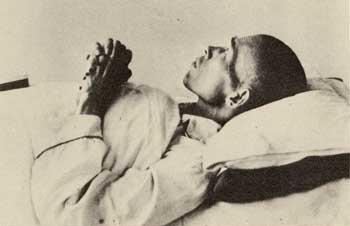
Dr.Nagaipraying
This is what I have heard. If it is true, the American pilots did not aim at Urakami. It was the providence of God that carried the bomb to that destination.
Is there not a profound relationship between the destruction of Nagasaki and the end of the war?
Nagasaki, the only holy place in all Japan—was it not chosen as a victim, a pure lamb, to be slaughtered and burned on the altar of sacrifice to expiate the sins committed by humanity in the Second World War?
The human family has inherited the sin of Adam who ate the fruit of the forbidden tree; we have inherited the sin of Cain who killed his younger brother; we have forgotten that we are children of God; we have believed in idols; we have disobeyed the law of love. Joyfully we have hated one another; joyfully we have killed one another. And now at last we have brought this great and evil war to an end. But in order to restore peace to the world it was not sufficient to repent. We had to obtain God’s pardon through the offering of a great sacrifice.
Before this moment there were many opportunities to end the war. Not a few cities were totally destroyed. But these were not suitable sacrifices; nor did God accept them. Only when Nagasaki was destroyed did God accept the sacrifice. Hearing the cry of the human family, He inspired the emperor to issue the sacred decree by which the war was brought to an end.
Our church of Nagasaki kept the faith during four hundred years of persecution when religion was proscribed and the blood of martyrs flowed freely. During the war this same church never ceased to pray day and night for a lasting peace. Was it not, then, the one unblemished lamb that had to be offered on the altar of God? Thanks to the sacrifice of this lamb many millions who would otherwise have fallen victim to the ravages of war have been saved.
How noble, how splendid was that holocaust of August 9, when flames soared up from the cathedral, dispelling the darkness of war and bringing the light of peace! In the very depth of our grief we reverently saw here something beautiful, something pure, something sublime. Eight thousand people, together with their priests, burning with pure smoke, entered into eternal life. All without exception were good people whom we deeply mourn.
How happy are those people who left this world without knowing the defeat of their country! How happy are the pure lambs who rest in the bosom of God! Compared with them how miserable is the fate of us who have survived! Japan is conquered. Urakami is totally destroyed. A waste of ash and rubble lies before our eyes. We have no houses, no food, no clothes. Our fields are devastated. Only a remnant has survived. In the midst of the ruins we stand in groups of two or three looking blankly at the sky.
Why did we not die with them on that day, at that time, in this house of God? Why must we alone continue this miserable existence?
It is because we are sinners. Ah! Now indeed we are forced to see the enormity of our sins! It is because I have not made expiation for my sins that I am left behind. Those are left who were so deeply rooted in sin that they were not worthy to be offered to God.
We Japanese, a vanquished people, must now walk along a path that is full of pain and suffering. The reparations imposed by the Potsdam Declaration are a heavy burden. But this painful path along which we walk carrying our burden, is it not also the path of hope, which gives to us sinners an opportunity to expiate our sins?
“Blessed are those that mourn for they shall be comforted.” We must walk this way of expiation faithfully and sincerely. And as we walk in hunger and thirst, ridiculed, penalized, scourged, pouring with sweat and covered with blood, let us remember how Jesus Christ carried His cross to the hill of Calvary. He will give us courage
“The Lord has given: the Lord has taken away. Blessed be the name of the Lord!”
Let us give thanks that Nagasaki was chosen for the sacrifice. Let us give thanks that through this sacrifice peace was given to the world and freedom of religion to Japan.
May the souls of the faithful departed, through the mercy of God, rest in peace. Amen.
(From The Bells of Nagasaki by Takashi Nagai, Kodansha International, 1984, pp.106-110)
Dr. Nagai's wife Maria died in that explosion as well. Shortly after the war ended, he was diagnosed with leukemia. Here he is with two of his children:
There are a couple of new book reviews up at Praise Of This Book.
Here is the link for the good review, which is a series of essays on the sources for J.R.R. Tolkien's works. It is called Tolkien and the Study of His Sources. I was impressed with the essays, especially after discovering that one of them was written by a professor at Texas A & M/Commerce.
Four years ago on this day, Fr. James Downey, OSB died. He was a Monk of St. Benedict's Abbey in Atchinson, Kansas. Part of his work was in the Pro-Life movement.
I knew him while I was in residency and fellowship. He referred to me as his private physician - probably the only person in the world who will ever consider me as that.
The anniversary of his death comes close on the heels of the HHS rule which will make contraceptives mandatory for all health insurance carriers. The U.S. Catholic bishops have properly voiced their opposition to this law which would make all those compliant to be guilty of mortal sin. It is ironic, though, that for so many years most priests and bishops have either opposed the Church's teaching on contraception and abortion or have remained silent on the subject, and now they expect the Faithful to join them in their fight against this ruling. Unfortunately, most poorly formed Catholics see no problem with contraception. Here is a video which explains it better than I ever could:
Thankfully, Fr. Downey was on the side of Life, and the Magesterium.
Eternal rest grant unto him, and may perpetual light shine upon him. May his soul, and all the souls of the Faithful Departed, through the Mercy of God, rest in peace.
Lifting the Wheel of Karma: A Profound Spiritual Journey of Extraordinary Healing and Redemption, by Paul H. Magid
Point Dume Press, 2012
"Ergo silebo." - J.R.R. Tolkien
"I think we must get it firmly fixed in our minds that the very occasions on which we should most like to write a slashing review are precisely those on which we had much better hold our tongues."
- C.S. Lewis
I seem to always be in the minority. I did not care for this book, and would not recommend it. I looked in vain for anyone who shared my opinion. When I keep finding objectionable things as I read a book, I finally get to the point where I have to reject the whole thing. And now, meditating on the words of Tolkien and Lewis up above, I shall make this review as constructive as possible.
I should start by saying that I do not reject this book because it presents Eastern religion or mysticism. I actually enjoyed the part of the book which discussed the various aspects of the Indian religions. As a reader, knowing this to be fiction, there were certain things which happened in this book (spoilers) which I took as plausible because they were consistent with the eastern mysticism presented in this book. In short, I went ahead and, for argument's sake, assumed some things to be true which I know to be not true. I would be more specific, but I would have to mention a spoiler.
I'll start with the things I did liked about the book. I think Mr. Magid described the settings very well, especially those of the scenes in India. I especially thought that he did a good job describing Lahiri's village and environs. Perhaps it's just reminded me of the time I spent in the mountains of Switzerland when I was a little boy. Either way, I felt as if I were in India, in the mountains.
Now onto the negatives........
Joseph's brother Bill accompanies him all the way to the other side of the world, traveling by airplane, rail, taxi, and finally even by ox-cart to reach their final destination in the Himalayas. Then, once Joseph meets up with Lahiri, Bill turns around and leaves. Just like that. He doesn't rest overnight before starting on the long journey home. He doesn't eat. Heck, he doesn't even go to the bathroom before leaving his brother. What about his return ticket? Did he know how long it would take to escort his brother to the mountains? These are the kind of inconsistencies which bother me about books. I finished the book still fretting over Bill leaving so abruptly.
Then there is the question of the wheelchair. Unless I misunderstood, the main character needs a wheelchair to get around. Not only does he need a wheelchair, but I think he also had use of only one hand, which would make an electric wheelchair an absolute necessity. I have a little experience with wheelchairs, from assisting my brother with his wheelchair, to transporting patients throughout a hospital while I was a college student, to spending an arduous day in one as part of our training in medical school. So it seemed a bit farfetched to have a character who relies on an electric wheelchair go off to a village so remote that he had to reach it riding in an ox cart. Every rock, carpeting, any slight pitch or camber in the sidewalk - not to mention curbs - were like insurmountable obstructions to my patients and I as we traveled along; just imagine that same wheelchair in a village without any 'advanced' amenities.
Don't get me started on things which were snuck through airport security......
Finally, there is the question of what constitutes a novel. Reading this book, I suddenly realized that I was halfway through it when I reached page ninety-five. Around the same time, I noticed the phrase 'A Novel' on the front cover. While the definition of a novel does not stipulate a certain number of pages to qualify, it does suggest that a novel should encompass a span of time completely, not sketchily. This book covers about fifty-five years in less than two hundred pages, leaving a lot of questions as to what happened in the gaps in the story. I figure that there could have been a lot of friendships made and broken, loves found and lost, and mayhem created which the author could have included in his book. This was the ultimate disappointment.
I suspect that most readers will disagree with me, but thats how it goes sometimes. I welcome you to read this book and make your own judgement on the merits of this book.
We have been following this blog ever since we met the family featured in it back in 2010. We met this family up in Pennsylvania at the house of a friend we have in common. They wanted to meet us because they liked my blog and wanted to meet me.
I would say that their blog is a lot cooler than mine.
I recently wrote a book review about a World War II pilot's experience in the CBI - the China/Burma/India Theatre. You can read it here.
In my review, I made a comment about the author trying to get credit for one more 'kill' - shooting down an airplane in combat - long after the fact. It struck me as odd that a man would be concerned with winning more glory for himself, especially as he approaches the end of his life.
The book made me think about what I would want people to remember about me after I am dead. Would I want to be remembered as the fighter pilot who shot down 'X' number of enemy aircraft during the war? Or is killing the enemy something which I would like to leave behind?
"That is not your Mosin Nagant you have. It belonged to others before you and will belong to others after you are gone. Look after it and pass it on with pride. It deserves it."
- Author Unknown
Finally, I took the Mosin Nagant 91/30 rifle out to the range. It had been almost a year since I bought it, and I hadn't been shooting recently, either. Of course, I still blogged about this Russian rifle twice: once when I first got it, and second when I left them outside in the summer heat to get some of the Cosmoline off of them. In this second posting, I made an interesting observation on the 'religiosity' of the Mosin Nagant.
Before taking it to the range, I took the gun apart. I did it to check out all the parts, make sure they all looked intact, and to clean all that Russian version of Vaseline known as Cosmoline. At the end of World War II, these rifles were refurbished and then dipped in vats of Cosmoline, a petroleum-based substance used to limit rust and corrosion. Then they were set aside, ready for the start of the Great Patriotic War against the Capitalistic American Enemy. That never happened, and so at some point people in Russia realized that people all over the world would pay under $100 for these surplus firearms, even if they were still smothered in a cake of old Cosmoline.
Notice that the economy has even hit the surplus firearm market. I payed a little bit more than $100 for mine, but not much.
One other thing was done for each Mosin Nagant. Each one was blessed, considering it could have been used for more than just defending Mother Russia. Combatants often abandon morals - recall news of some atrocious behavior by our Marines in Afghanistan - and I did not want to have what could have been a weapon of oppression in my house.
As I said, I took this gun apart to clean it. If you don't do this, the cosmoline tends to ooze out of all the nooks and crannies as the rifle heats up. Then you have to clean off more than just the usual metal and gunpowder reside off of your hands.
It got really hot when we shot it, by the way.
I noticed that there was an additional bolt in the stock of this rifle. When I looked inside I saw that there was a break in the stock where the wood bridged from one side to the other
Another thing I forgot to mention was that the armorers seemed to be a little stamp-crazy when they worked on these. Nearly every flat surface would have some sort of symbol or letter - some of them Cyrillic - indicating Lord only knows what about the rifle. There are online resources which can help decipher the marks. In the case of this rifle, it was made in 1942 at the Izhevsk weapons manufacturing plant in Russia. Typically the serial number is stamped on the receiver, the base plate of the magazine, and the butt plate. In my case, all three serial numbers are the same, indicating that those were probably the original parts rather than those scavenged from another rifle.
After I put it back together, this is what it looked like. Of course, I still don't know what those few leftover pieces were supposed to go.......
Then I put it on my bedroom floor and took another picture, complete with my unpolished boots.
Game Day. We took it to Elm Fork Shooting Sports in Dallas. It is located in a bad part of town, unfortunately. I told the children to avoid looking at the advertisements; most of the businesses around there were the kind that one finds around firing ranges, airports, and military installations. Sad.
Still, the folks there were really nice. I realized that the business card I had gotten from them last year - complete with holes punched in it - was actually a ticket for 10 visits to the rifle/pistol or shotgun ranges. In other words, I had already paid for our shooting that day. Woo-hoo!
We got a lane in the 'tactical' part of the range so we could shoot both rifle and pistols without moving around a lot. Here the Mosin Nagant is lying on the bench, and the target is 30 yards away.
I wanted to shoot it first, not only because IT'S MY TOY, but also because I knew from my reading that there was a small chance that the firing pin could penetrate the primer too much and cause some of the escaping gases to spray back toward the operator. I donned protective eyewear to go over my glasses, and assumed the position. I lined up the center 'X' with the sights, and tried to control my breathing and steadying my aim. I suddenly glanced at the end of the bolt, where a scratch made by some armorer long ago indicated that the firing pin was positioned correctly. I started to think about that Canadian rifle from World War I, the one with the straight-pull bolt, which had a nasty tendency to occasionally slam back into the eye of the soldier. I said a quick prayer to my guardian angel, took aim, breathed in, exhaled slowly, and gently squeezed the trigger.
Bam!
Not bad. The kick wasn't as bad as I thought it would be. I studied the target. I was sure I must have hit the target. I mean, there was no way that this old rifle, well known for its accuracy, could have not hit the target. Nothing. I was dumbfounded. I slid back the bolt, ejecting the first spent shell, and fed in the next cartridge into the receiver. I still couldn't believe it. I had totally missed the target!
Just then I noticed that there was an unusually large hole in the target to the right of mine. Two men at the station next to us were having a field day shooting off .223 caliber rounds. They had a whole bunch of weapons laid out, including at least one AK-47, but at that time they were shooting the smaller caliber AR-15 bullets. They either did not notice, or did not care, that a larger bullet (approximately .30 caliber) had suddenly joined their groupings.
Well that was it. Here I am firing it. We tried using the little stripper clips to speed load it, but they did not work. We shall have to try it some other time. This is me:
Here Benedict(15) shoots the Mosin Nagant from a standing position. You can get a good look at the rifle and how fun it is to shoot.
As we continued firing, eventually putting 60 rounds through it, I noticed a few things. One is that the barrel and receiver got really hot. I burned my thumb when I touched it one time, and I noticed that the heat coming off the barrel made the target seem to swim in the sights. I also noticed that the action seemed stiffer and harder to work. Then there was the shoulder discomfort. My shoulder is still a little sore today. When you watch Cornelius (11) shoot, you can see how the bolt seems to be fighting us and that the recoil could really do a number on one's shoulder or collarbone:
Each of us shot almost 20 rounds through the Mosin Nagant; one of my daughters did accompany us and at least shot it once just to see what it was like. By the end of the day, all I could think about was how hard it must be shooting that rifle while German soldiers charge at you. Another reason to pray for peace.
The next day, I shot pellet guns in the back yard with some of the younger boys. That will have to be another story for another day:
A fifty year old British-made Godzilla-Wanna-Be Monster Movie gets me thinking about Irish Citizenship, the song 'Four Green Fields,' and Ireland in general.
What did I have, said the fine old woman
What did I have, this proud old woman did say
I had four green fields, each one was a jewel
But strangers came and tried to take them from me
I had fine strong sons, who fought to save my jewels
They fought and they died, and that was my grief said she
I am eligible for Irish citizenship, if I want to go through the trouble of getting it. My mother's parents were both born in Ireland, and so all I need to do is show proof that my grandfather, Manus O'Donnell, was born over there. After that, it should be simple to get ample proof that my mother is his daughter and that I am her son. I thought it would be easy, until I looked over copies of some documents my mother had about Grandpop. There was no copy of a birth certificate; in addition, the various documents all had my grandfather born on a different day. It appears as if I would have to do more research in order to obtain duel citizenship.
Nowadays I have a better reason to forget about becoming an Irish citizen. Recently, I read that Ireland closed its embassy to the Vatican. The reason given was that the embassy was not producing anything of economic value for Ireland, and with the poor economy, certain government functions which had little benefit would have to go. This just seems to be another part of the European Union's campaign to deny its Christian - or dare I say, Catholic - origins. Economic value? Was that the reason St. Patrick returned to Ireland to spread the Faith? Now that the European economy is hurting - and ours is too - the Irish may find that they will be needing some of their cultural roots to make it through hard times. Perhaps they will find out it Jim Stenson was right when he referred to CHARACTER as what you have left when all the money is gone......
Never mind about dual citizenship; I'll stay a Texan. Sure, all my ancestors were from Ireland, but far more important is my Catholic Faith. My Faith is reflected in the names of our children, which represent a lot of nationalities, from the Pole Maximilian Kolbe, to the Roman soldier St. Theodore Tyro, to the Mexican priest Blessed Miguel Pro. This is far more important than my Irish heritage. It does make me wonder, though, just how many of those saints were started on the road to Heaven thanks to an Irish missionary.
Plot Summary
These are the kinds of thoughts which kept running through my mind as I watched the movie Gorgo, which on the surface looks as if it is just a British version of Godzilla. Briefly, Gorgo starts off the coast of Ireland by the fictional Nara Island. A salvage ship enters the port after being damaged by a squall precipitated by some sort of undersea earthquake or volcano. While making repairs, the crew witness a giant sea creature attacking the villagers. After a pitched battle, the creature is driven back into the ocean. For some reason Joe Ryan, the captain of the salvage vessel, and the First Mate, Sam Slade, decide that this creature may be worth capturing. This is the first bad idea of the movie, and like all those Japanese monster movies, there is an annoying child around who warns the ambitious captain to leave the creature alone.
Long time ago, said the fine old woman
Long time ago, this proud old woman did say
There was war and death, plundering and pillage
My children starved, by mountain, valley and sea
And their wailing cries, they shook the very heavens
My four green fields ran red with their blood, said she
The salvage crew captures the sea creature in a sequence which defies logic. When the Irish government finds out about it, they send a couple of experts from a Dublin university to claim it and take it to be studied. Our salvage crew decides to follow the money and instead take an offer to display it at a carnival located in London. This makes perfect sense to me, as I don't know of any famous buildings in Dublin which could be destroyed by a rampaging monster. London, on the other hand, has a lot of cool tourist sites.
The annoying child stows away on the boat and tries to free the creature. When he is unsuccessful, he once again warns Joe and Sam about the danger they face taking this creature away from his home. Of course they ignore him.
Anyways, the creature is delivered to the carnival with a few of the crew of the ship getting killed in the process. This doesn't seem to bother Joe, but Sam begins to have second thoughts about what they have done. They also are responsible for the welfare of that annoying child, who was actually an orphan. It is almost like a foreshadowing of the TV series Two and a Half Men.
At this point, Joe and Sam are informed by some British paleontologists that the creature they captured is probably not full grown. And, to paraphrase one of the scientists, where there are infants, there are usually parents....
Reflections on Gorgo
What follows may be considered SPOILERS. You have been warned.
What have I now, said the fine old woman
What have I now, this proud old woman did say
I have four green fields, one of them's in bondage
In stranger's hands, that tried to take it from me
But my sons had sons, as brave as were their fathers My fourth green field shall bloom once again, said she.
So, two thoughts came to me as I watched this movie. First of all, the mother monster behaves just like any creature with a maternal instinct. She goes and retrieves her cute little hideous baby monster, defying all that the British Army, Navy, and Air Force can throw at her. When she finds her child, she turns around and, ignoring all of London which has not been devastated, swims back to her undersea lair.
I initially took this as a metaphor for Ireland fighting for her independence from England, where the monster just wanted to get her 'fourth green field' back. In this case the monster child is the last county still 'in bondage,' under the control of England. I guess this was still an issue in 1960; I know that as late as the 1970's there were folks in the United States who were raising money for the Irish Republican Army. At the time of release of this movie, this seemed like a plausible metaphor for the movie: the British steal something from Ireland, and Ireland goes and retrieves it.
With the current situation in Europe and Ireland, I have a little different take on this movie. Perhaps the baby monster represents Ireland - and Europe too - being stolen away from its Christian roots in favor of a materialistic society. Throughout the movie, money is the only thing which motivates Joe and Sam. Warnings from the innocent - but still annoying - child are ignored. The deaths of many islanders and sailors do not deter them from bringing Gorgo to the financial center of one of the world's former great powers. And finally, all of the weapons that man can muster are unable to defeat the creature- a creature which only takes that which is rightfully hers. In a strange way justice prevails, and the constructs of man are left in ruins. Ireland is returned to the bosom of Holy Mother Church, we hope.
Or maybe, like the song says, "History shows again and again how nature points out the folly of man."
Postscript: What does Samuel Beckett have to do with this movie?
I didn't buy this movie; nor did I get a free copy in exchange for this review. No, I watched it on YouTube while walking on the treadmill. Just to make matters more complicated, I actually watched the Mystery Science Theater 3000 version of the movie, which featured Mike Nelson and the Robots making sarcastic comments throughout. One of the more esoteric references made by the 'Bots was how one of the characters looked like the Irish poet Samuel Beckett. For the remainder of that characters 'life' on screen, references were made to several works by Mr. Beckett. One of the more famous of his works was an absurdist play called Waiting for Godot, which has been the subject of much speculation and controversy ever since its appearance in 1953. The play is about two characters waiting for another character named Godot, who never does arrive.
MST 3K did their own version of this play in one of their skits between commercial and movie:
If you like movie reviews and want to read some really good ones which usually tie in to the Faith, I recommend you look at the B-Movie Catechism. This blog really does an excellent job and was my inspiration for writing this review.
Mary my mother, take my hand today, and all days. Lead me away from all occasions of sin. Guide me in fulfilling your last words in the Gospel, "Do whatever He tells you." Amen.
I used to have a section here where I listed some of my interests, but I was saddened to see that it linked my site to folks who had, well, behavior not really in line with that of a Catholic working hard to be a good dadwithnoisykids.
We have 12 living children, and their ages are: 21, 19, 17, 16, 15, 13, 12, 10, 9, 7, 5, and 2 years old.
Our third child, Theodore, passed away on April 3, 2008, at the age of 15.