I invite you to sign The Manhattan Declaration

The Manhattan Declaration

Theodore's Memorial Video

Showing posts with label Saints. Show all posts

Monday, February 06, 2012

Feast of the Martyrs of Nagasaki, Japan in 1597

February 6th is the Feast of the Martyrs of Nagasaki.  In 1597, St. Paul Miki and Companions were crucified on a hill overlooking Nagasaki.

Shorty before the United States entered the Second World War, a Japanese man took Paul - from St. Paul MIki - as his baptismal name.  Paul Takashi Nagai was a physician in Nagasaki, and he survived the atomic bomb which was dropped on it on August 9, 1945.  He pointed out, in a speech given for the funeral for the 8,000 Catholics who died in Nagasaki, how the Cathedral had been offered up as a sacrifice for an end to the war:

On August 9, 1945, at 10:30 A.M. a meeting of the Supreme Council of War was held at the Imperial Headquarters to decide whether Japan should capitulate or continue to wage war. At that moment the world was at a crossroads. A decision was being made that would either bring about a new and lasting peace or throw the human family into further cruel bloodshed and carnage.    
And just at that same time, at two minutes past eleven in the morning, an atomic bomb exploded over our district of Urakami in Nagasaki. In an instant, eight thousand Christians were called into the hands of God, while in a few hours the fierce flames reduced to ashes this sacred territory of the East. At midnight of that same night the cathedral suddenly burst into flames and was burned to the ground. And exactly at that time in the Imperial Palace, His Majesty the Emperor made known his sacred decision to bring the war to an end.

On August 15, the Imperial Rescript which put an end to the fighting was formally promulgated, and the whole world welcomed a day of peace. This day was also the great feast of the Assumption of the Virgin Mary. It is significant to reflect that Urakami Cathedral was dedicated to her. And we must ask if this convergence of events—the ending of the war and the celebration of her feast—was merely coincidental or if there was here some mysterious providence of God.

I have heard that the second atomic bomb, calculated to deal a deadly blow to the war potential of Japan, was originally destined for another city. But since the sky over that city was covered with clouds, the American pilots found it impossible to aim at their target. Consequently, they suddenly changed their plans and decided to drop the bomb on Nagasaki, the secondary target. However, yet another hitch occurred. As the bomb fell, cloud and wind carried it slightly north of the munitions factories over which it was supposed to explode and it exploded above the cathedral.
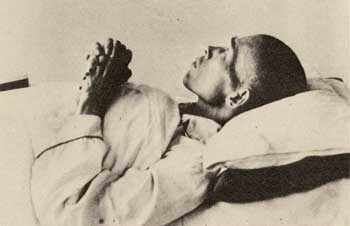
  Dr. Nagai praying
 
Dr. Nagai praying
This is what I have heard. If it is true, the American pilots did not aim at Urakami. It was the providence of God that carried the bomb to that destination.

Is there not a profound relationship between the destruction of Nagasaki and the end of the war? 

Nagasaki, the only holy place in all Japan—was it not chosen as a victim, a pure lamb, to be slaughtered and burned on the altar of sacrifice to expiate the sins committed by humanity in the Second World War?

The human family has inherited the sin of Adam who ate the fruit of the forbidden tree; we have inherited the sin of Cain who killed his younger brother; we have forgotten that we are children of God; we have believed in idols; we have disobeyed the law of love. Joyfully we have hated one another; joyfully we have killed one another. And now at last we have brought this great and evil war to an end. But in order to restore peace to the world it was not sufficient to repent. We had to obtain God’s pardon through the offering of a great sacrifice.

Before this moment there were many opportunities to end the war. Not a few cities were totally destroyed. But these were not suitable sacrifices; nor did God accept them. Only when Nagasaki was destroyed did God accept the sacrifice. Hearing the cry of the human family, He inspired the emperor to issue the sacred decree by which the war was brought to an end.

Our church of Nagasaki kept the faith during four hundred years of persecution when religion was proscribed and the blood of martyrs flowed freely. During the war this same church never ceased to pray day and night for a lasting peace. Was it not, then, the one unblemished lamb that had to be offered on the altar of God? Thanks to the sacrifice of this lamb many millions who would otherwise have fallen victim to the ravages of war have been saved.

How noble, how splendid was that holocaust of August 9, when flames soared up from the cathedral, dispelling the darkness of war and bringing the light of peace! In the very depth of our grief we reverently saw here something beautiful, something pure, something sublime. Eight thousand people, together with their priests, burning with pure smoke, entered into eternal life. All without exception were good people whom we deeply mourn.

How happy are those people who left this world without knowing the defeat of their country! How happy are the pure lambs who rest in the bosom of God! Compared with them how miserable is the fate of us who have survived! Japan is conquered. Urakami is totally destroyed. A waste of ash and rubble lies before our eyes. We have no houses, no food, no clothes. Our fields are devastated. Only a remnant has survived. In the midst of the ruins we stand in groups of two or three looking blankly at the sky.

Why did we not die with them on that day, at that time, in this house of God? Why must we alone continue this miserable existence?

It is because we are sinners. Ah! Now indeed we are forced to see the enormity of our sins! It is because I have not made expiation for my sins that I am left behind. Those are left who were so deeply rooted in sin that they were not worthy to be offered to God.

We Japanese, a vanquished people, must now walk along a path that is full of pain and suffering. The reparations imposed by the Potsdam Declaration are a heavy burden. But this painful path along which we walk carrying our burden, is it not also the path of hope, which gives to us sinners an opportunity to expiate our sins?

“Blessed are those that mourn for they shall be comforted.” We must walk this way of expiation faithfully and sincerely. And as we walk in hunger and thirst, ridiculed, penalized, scourged, pouring with sweat and covered with blood, let us remember how Jesus Christ carried His cross to the hill of Calvary. He will give us courage

“The Lord has given: the Lord has taken away. Blessed be the name of the Lord!”

Let us give thanks that Nagasaki was chosen for the sacrifice. Let us give thanks that through this sacrifice peace was given to the world and freedom of religion to Japan.

May the souls of the faithful departed, through the mercy of God, rest in peace. Amen.

(From The Bells of Nagasaki by Takashi Nagai, Kodansha International, 1984, pp.106-110)

Dr. Nagai's wife Maria died in that explosion as well.  Shortly after the war ended, he was diagnosed with leukemia.  Here he is with two of his children:


D

Saturday, December 31, 2011

Memories of St. Sylvester's Feast Day

In Switzerland, St. Sylvester's Feast Day was known as Sylvestertag.  One can read about the life of Pope St. Sylvester in other  places; here I shall relate the how the Swiss observed the celebration of Sylvestertag.  In particular, I shall relate how my brothers and I celebrated it while we were living in Switzerland 'way back in 1972.  At that time, we were living in a small village called Dürnten, located in the Canton of Zürich.  Cantons are sort of like states in the U.S., only that Switzerland is closer to the size of some of our states.....


I did find a reference which almost matched what we did.  One thing which I can't reconcile is that I thought that we celebrated Sylvestertag before Christmas rather than after.  Either way, it was quite an interesting activity for an eight year old boy:

Since Silvester Abend, or “Sylvester’s Eve,” is also New Year’s Eve, many Germans and Austrians hold late-night parties. In Germany these festive gatherings may include drinking, eating, dancing, singing, and fortune-telling.

 The only thing I don't recall seeing was fortune-telling.  This party started out in the wee hours of the morning, and ended up at the village school.  We attended the local public school, but there were no problems with having a 'Christian' celebration on the premises.  Read on:

In at least one Swiss town—Urnäsch in Appenzell Canton—bands of 'mummers' known as “Silvesterclausen” still parade through the streets in costumes, bells, and headdresses on December 31, as well as on St. Sylvester’s Day Old Style, which falls on January 13. They visit homes, yodel three times, and are rewarded with wine by the occupants.


That's what I recall, with some modifications.  I remember getting up in the early hours of the morning, maybe around 2 a.m., and joining up with my classmates as we went through the village making noise.  We did more than yodel; people were banging on drums and using cowbells to wake up the occupants of the village.  When I say cowbells I am referring to the huge Swiss cowbells, rather than the puny cowbell used in the infamous 'more cowbell' skit.  Here is a selection of Swiss cowbells; we were using the larger ones:

Another difference is the whole issue of wine.  Most of the children already had wine to drink as they made their way toward the school; most of them were also smoking.  This was the most bizarre part of the festivities, even if all my classmates were two years older than me.  Our parents forbade us to smoke or drink while we were out that morning.  They wanted us to try smoking and drinking alcohol under controlled conditions where they could be present.  More on that later.


Even better than wine were the little treats and cakes which we got from the homes.  I don't recall what they looked like, but this is the best image I could find when I googled images of Sylvestertag.  It looks like a half-eaten donut:


Around daybreak, we arrived at the school, where my classmates performed skits and played music for our entertainment.  It is the only time that I really enjoyed accordion music.

Several days later, at home, our parents let us try smoking cigarettes.  They gave us four boys a pack of cigarettes and let us try them.  I didn't like it, probably because I was inhaling.  Ever since then, I have had an aversion to smoking.  I have only smoked a few cigars since then; the most memorable one was a Cuban cigar which I tried while on temporary duty in El Salvador back in 1998.

Then a few days after trying smoking, our parents allowed us to try drinking alcohol.  Vermouth.  We diluted it with ginger ale, or some kind of lemon-lime soda, but I still recall it as being nasty.  

Sylvestertag was one of many adventures we had while living in Switzerland.  While it was one of the more bizarre things we saw while living there, it still was great to see how other cultures live and celebrate.


Me, Francis, Fr. Denis, and Matthew.  Patrick was to arrive five years after this picture was taken.

Saturday, December 03, 2011

St. Nicholas Day Party

We went to the St. Nicholas Feast Day Party at Mater Dei Catholic Church in Irving today.

We put together some food and some ornaments that the children made, and got a table to sell our wares.  At first, business was slow.  I thought it was because of the economy, and people were inclined to watch their money a bit closer.  I also thought they may have been worried about the local version of 'Occupy Wall Street' might drop in to protest the corporate greed of the family-based Catholic entrepreneur.  All I need is to have 'Occupy Mater Dei' show up and insist that we distribute the goodies we made for free to all the people who can't find a job.

Thankfully that did not happen, and after a while we started selling.  I think people took a look at everything before deciding on purchases.  We had a near monopoly on food, so things went well.  For a time, the homemade 'sleighs' were literally FLYING off the table.

Here Zelie takes a break in the action to wolf down a sandwich before the next onslaught of consumers:


We sold candied pecans - not our own pecans, sadly - and brownies, cookies, banana bread, and blueberry muffins.  We sold two types of Christmas ornaments: some were plastic ones where you bake them in the oven to fill the colors of the ornaments.  The others were made with barbed wire from our property, shaped like Texas, and then backed with felt pieces that resembled the Texas flag.  Here is an example:


But the biggest sellers were our sleighs, made with small candy canes, KitKat candy bars, and either a little box of Nerds or Junior Mints.  With little bit of ribbon and tape, we made them into the shape of a sled, or sleigh:

The kids covered the Nerds or Junior Mints with aluminum foil.  As I said, these treats literally flew off the table.


There were craft projects for the children to do, and a little train which rode around in the parking lot.  The rain put a damper on the outside activities right around the time that the inside show started.  Here Bernard, held by his Godfather Nathaniel, watches a puppet show featuring large mice and a nun that sings.  He was fascinated by it.

The final part of the show was when St. Nicholas showed up.  Here he is, exhorting the children to be good:

Here are three of the children ZelieLouisa, Maximilian, and Marcellinus watching St. Nicholas, looking a bit bored.
I missed them greeting St. Nicholas, so I had them come back up for a picture.  This was really inconvenient for Max, so this is as close to a smile as I could get.
The man who portrayed St. Nicholas, the German dancers, the puppeteers, all made it a wonderful day for the children.  Well done!

Wednesday, November 30, 2011

St. Andrew Christmas Novena Prayer to Obtain Favors

Rather than rewriting this, I just copied it from previous years.  I am not sure why I included book reviews along with this prayer last year, though.


St. Andrew Christmas Novena Prayer to Obtain Favors


Hail and blessed be the hour and moment in which the Son of God was born of the most pure Virgin Mary, at midnight, in Bethlehem, in piercing cold. In that hour, vouchsafe, O my God! to hear my prayer and grant my desires, through the merits of Our Saviour Jesus Christ, and of His Blessed Mother. Amen.


(It is piously believed that whoever recites the above prayer fifteen times a day from the feast of St. Andrew (30th November) until Christmas will obtain what is asked.)
Imprimatur

+MICHAEL AUGUSTINE, Archbishop of New York
New York, February 6, 1897

Tuesday, November 29, 2011

25 Years Ago This Month......

I met Blessed Teresa of Calcutta in Washington, DC. I asked to pray for me since I had just been accepted to medical school.

Her sisters in Dallas are still praying for me.

Blessed Teresa, pray for us!

Sunday, July 17, 2011

July 17, 1794


A shining example of fortitude, faith, obedience, and humility.  They died as obedient sisters to the last, asking for permission to die from their Prioress before climbing up to the guillotine.

Saturday, July 16, 2011

The Holy Martyrs of Compeigne

Laudate Dominum omnes gentes
Laudate eum, omnes populi
Quoniam confirmata est
Super nos misericordia eius,
Et veritas Domini manet in aeternum.

Gloria Patri et Filio et Spiritui Sancto.
Sicut erat in principio, et nunc, et semper.
Et in saecula saeculorum.
Amen.*


This weekend we remember the Holy Martyrs of Compeigne, who were beheaded with the guillotine on July 17, 1794 in Paris, France.

This is a picture of a small statue of the Blessed Mother holding Jesus, which was kissed by each nun before she climbed the ladder up to the executioner:


The nuns are listed below, or can be found at this website:


  • Madeleine-Claudine Ledoine (Mother Teresa of St. Augustine), prioress, b. in Paris, 22 Sept., 1752, professed 16 or 17 May, 1775;
  • Marie-Anne (or Antoinette) Brideau (Mother St. Louis), sub-prioress, b. at Belfort, 7 Dec., 1752, professed 3 Sept, 1771;
  • Marie-Anne Piedcourt (Sister of Jesus Crucified), choir-nun, b. 1715, professed 1737; on mounting the scaffold she said "I forgive you as heartily as I wish God to forgive me";
  • Anne-Marie-Madeleine Thouret (Sister Charlotte of the Resurrection), sacristan, b. at Mouy, 16 Sept., 1715, professed 19 Aug., 1740, twice sub-prioress in 1764 and 1778. Her portrait is reproduced opposite p. 2 of Miss Willson's work cited below;
  • Marie-Antoniette or Anne Hanisset (Sister Teresa of the Holy Heart of Mary), b. at Rheims in 1740 or 1742, professed in 1764;
  • Marie-Françoise Gabrielle de Croissy (Mother Henriette of Jesus), b. in Paris, 18 June, 1745, professed 22 Feb., 1764, prioress from 1779 to 1785;
  • Marie-Gabrielle Trézel (Sister Teresa of St. Ignatius), choir-nun, b. at Compiègne, 4 April, 1743, professed 12 Dec., 1771;
  • Rose-Chrétien de la Neuville, widow, choir-nun (Sister Julia Louisa of Jesus), b. at Loreau (or Evreux), in 1741, professed probably in 1777;
  • Anne Petras (Sister Mary Henrietta of Providence), choir-nun, b. at Cajarc (Lot), 17 June, 1760, professed 22 Oct., 1786.
  • Concerning Sister Euphrasia of the Immaculate Conception accounts vary. Miss Willson says that her name was Marie Claude Cyprienne Brard, and that she was born 12 May, 1736; Pierre, that her name was Catherine Charlotte Brard, and that she was born 7 Sept., 1736. She was born at Bourth, and professed in 1757;
  • Marie-Geneviève Meunier (Sister Constance), novice, b. 28 May, 1765, or 1766, at St. Denis, received the habit 16 Dec., 1788. She mounted the scaffold singing "Laudate Dominum". In addition to the above, three lay sisters suffered and two tourières. The lay sisters are:
  • Angélique Roussel (Sister Mary of the Holy Ghost), lay sister, b. at Fresnes, 4 August, 1742, professed 14 May, 1769;
  • Marie Dufour (Sister St. Martha), lay sister, b. at Beaune, 1 or 2 Oct., 1742, entered the community in 1772;
  • Julie or Juliette Vérolot (Sister St. Francis Xavier), lay sister, b. at Laignes or Lignières, 11 Jan., 1764, professed 12 Jan., 1789.
The two tourières, who were not Carmelites at all, but merely servants of the nunnery were: Catherine and Teresa Soiron, b. respectively on 2 Feb., 1742 and 23 Jan., 1748 at Compiègne, both of whom had been in the service of the community since 1772.

I have reviewed the book To Quell the Terror in the past; I strongly recommend this book rather than the fictionalized account of this incident found in the more famous book called The Song at the Scaffold by Gertrude von Le Fort.  Another great reference I found online is this blog.

Before going out to their execution, the Prioress obtained some hot chocolate for the nuns; it was their only nutrition they received for the last 24 hours of their lives.  In honor of them, I plan on making a big cup of hot chocolate to drink in honor of these wonderful women who died 217 years ago this weekend.

Besides, I have to de-scale my coffee maker this weekend.


*Praise the Lord, all nations;
Praise Him, all people.
For He has bestowed
His mercy upon us,
And the truth of the Lord endures forever.
Glory to the Father and to the Son and to the Holy Spirit,
as it was in the beginning, is now, and forever,
and for generations of generations.
Amen.

Wednesday, May 25, 2011

St. Albert and the Worm Dissection

WARNING: GRAPHIC IMAGES OF WORM INNARDS FOLLOW.

YOU HAVE BEEN WARNED!


Yesterday, we dissected worms as part of our St. Albert Science Class.

After starting with prayer, we sat down and discussed the various functions which animals have to carry out in order to live and thrive in this world. In brief, we talked about how most animals have to:

Breathe
Eat
Move about
Make baby animals

Along with this short and incomplete list, I added:

Circulation
Excretion or elimination of waste products
A nervous system to control all of these functions

All of these functions can be seen rather easily in the lowly earthworm, Lumbricus terrestris. Here is a picture of an earthworm in happier times:


This discussion superficially covered these functions mentioned above. The children were not as interested in 'functions of an animal' as they were keen on asking other questions, such as:

Is the worm still alive?
Could it come alive if we put it into the ground?
Do scientists and doctors dissect people?

Cadaver dissections is something I can talk about, and that started a HUGE side discussion. I told them a little about what it was like to dissect a human body in medical school. I explained where the bodies came from, how they were donated by people before death, and this was a tremendous gift they had done for the field of medicine. I mentioned that my cadaver in anatomy lab was a man with a tattoo of the name 'Ann' on one of his arms. I also mentioned that I pray for the repose of that man's soul whenever I think of him.

They wanted to know what it smelled like. I forgot to tell them that we wore clothes designated for anatomy lab and nothing else so they could be thrown out at the end of the semester. As I write this, I recall how it took a while to get the odor of formaldehyde out of my system after lab. Thankfully, our worms came in a different type of preservative which smelled bad, but not as awful as formaldehyde.

As an aside, I skipped over the fact that earthworms are hermaphrodites, where they have both male and female parts for making little worms. For the sake of this class, we considered this worm to contain 'reproductive organs' for producing eggs. Our children can learn the details of reproduction later.

Originally we were going to do the dissection out in the open air, but the wind was too strong, so we did it in the school room.

We prepared for the class by getting some thick cardboard to use as the dissection boards. We got out a container of surgical instruments and dissecting implements we had set aside for classes like this. Our older children had used them in the local home school co-op; Nathaniel assisted me and his siblings by showing them how to dissect the worm. I reminded them that scalpels and knives are used very little in dissection. This is why we could use one scalpel to dissect five worms; this made the class safer than if every child were waving around a #15 blade.

I had obtained the used surgical instruments not by theft but by getting broken instruments from the sterile supply department of one of the hospitals I worked at in San Antonio. At that time (1998), we were dissecting frogs, and I wanted some tools for the job. The head of sterile supply, once he realized why I wanted the instruments, let me look through a barrel full of hemostats, forceps, scissors, needle drivers and probes which were too damaged to be repaired or reused for surgery. They still could be used for frog dissection, though. We held onto those instruments for other dissection classes. The only thing I bought recently for dissection were some disposable scalpel blades.

We used non-sterile gloves bought at Costco. Max brought along his own device to limit the smell:


After pinning the worm to the cardboard and identifying external markings on it, we all made a small incision on the dorsum, or back, of the worm, and then used scissors to open it up for inspection. Here is where the pins really came into play:

Looks kinda gross, eh? The anterior, or front, part of the worm is where all the business takes place. After the first two or three inches, the body of the worm consists of repeating segments which only contain the digestive, excretory, nervous, and respiratory system. Muscles in the wall of the body help move it. For this reason, we did not fillet the whole worm.

The internal anatomy shows what the highest priorities are for a worm. The major system is the digestive system, which is the dark tube running the length of the body. At the front of the worm, the digestive system consists of a mouth, pharynx, esophagus, crop, and gizzard. I explained how the worm, like the chicken, has no teeth, and must find another way to grind up food. This led to a side discussion of the Thanksgiving turkey, and all the little bits of turkey which come in a little bag inside of it. I reminded them of the gizzard which the turkey uses to grind up seeds and grain, and how this is similar to the one the worm uses.

Some of the children looked uneasy. Perhaps we won't be having turkey this Fall....

The next biggest organ system are those for making little worms. In comparison, the brain is barely recognizable. It shows that worms spend very little time writing sonnets to their loved one or blogging about books they have read. Most of the white things in the picture below are for reproduction.


After cleaning up, we reviewed some of the functions of an animal, and how they are accomplished by the lowly earthworm. I also talked about how important worms are to our soil. Recently, I tilled the garden, and I only saw one worm in the soil. In the future we may be raising worms to help our North Texas soil grow more than just grass.

I don't think any of the children walked away from this wanting to go to medical school, but there is still time....

St. Albert, pray for us!


Wednesday, May 18, 2011

Advice from St. Stephen of Hungary to his son St. Emeric

My dearest son, if you desire to honor the royal crown, I advise, I counsel, I urge you above all things to maintain the Catholic and Apostolic faith with such diligence and care that you may be an example for all those placed under you by God, and that all the clergy may rightly call you a man of true Christian profession.

Failing to do this, you may be sure that you will not be called a Christian or a son of the Church. Indeed, in the royal palace, after the faith itself, the Church holds second place, first constituted and spread through the whole world by His members, the apostles and holy fathers, And though she always produced fresh offspring, nevertheless in certain places she is regarded as ancient.

However, dearest son, even now in our kingdom the Church is proclaimed as young and newly planted; and for that reason she needs more prudent and trustworthy guardians less a benefit which the divine mercy bestowed on us undeservedly should be destroyed and annihilated through your idleness, indolence or neglect.

My beloved son, delight of my heart, hope of your posterity, I pray, I command, that at very time and in everything, strengthened by your devotion to me, you may show favor not only to relations and kin, or to the most eminent, be they leaders or rich men or neighbors or fellow-countrymen, but also to foreigners and to all who come to you. By fulfilling your duty in this way you will reach the highest state of happiness. Be merciful to all who are suffering violence, keeping always in your heart the example of the Lord who said: “I desire mercy and not sacrifice”. Be patient with everyone, not only with the powerful, but also with the weak.

Finally be strong lest prosperity lift you up too much or adversity cast you down. Be humble in this life that God may raise you up in the next. Be truly moderate and do not punish or condemn anyone immoderately. Be gentle so that you may never oppose justice. Be honorable so that you never voluntarily bring disgrace upon anyone. Be chaste so that you may avoid all the foulness that so resembles the pangs of death.

All these virtues I have noted above make up the royal crown and without them no one is fit to rule here on earth or attain to the heavenly Kingdom..


Thursday, March 03, 2011

The Return of St. Albert the Great


Back in 1998 I put together a science class for some of the homeschooling boys. I called it the St. Albert the Great Science Club, under the patronage of St. Albert, patron saint of scientists. I would have a class every month, on a Saturday, and I only did it that year. It was a big success, and Carolyn had been after me for a while to start it up with a younger generation of our children.

I said I would work on it. I looked over some notes, and thought about it. Someday I would get around to starting it.

That someday was today. I was off work early, and Carolyn told the kids and I that we could hold our first class that day. I gulped real hard and said I would be ready. Then I headed off to the store to get the materials, the missing ingredient, for our first experiment. When I got back from the store, some Mexican hot chocolate was waiting for me - a gift from some friends of ours in San Antonio. Like most Mexican treats, it was heavy on the sugar. After one cup of lactose-free Abuelita cocoa, I was ready to take on the world.


Briefly I discussed the reason for the class, starting with a definition of science, and then discussing the reasons for the study of science. I discovered a great reference for this subject; namely, the 'why study science' in the context of our Catholic Faith. I found this in a book called For the Beauty of the Earth, by Klassen et. al. and published by St. Paul's Publishing Company (1983). I was surprised to see it dedicated to John Senior, Dennis Quinn, and Frank Nelick; these were the founders of the Integrated Humanities Program at the University of Kansas in the early 1970's. This program resulted in a lot of students converting to the Faith; some of them felt a calling to the consecrated life. A few of those called to the religious life joined the Benedictine monastery at Fontgombault in France, and then returned to the United States to establish the Benedictine Monastery at Clear Creek. It is amazing to see the fruits of the work of these three men almost forty years after.

I am still working my way slowly through John Senior's book, The Death of Christian Culture.

Here is the list for why we study science, broken down into what are considered the 'ends,' or reasons for studying science. I found these listed in some other Catholic science books - in more child friendly terms - but I like this list for my own benefit:

After discussing the 'why,' we discussed the scientific method, and the various parts of it. It was a lively discussion, with my students ranging in age from 5 to 14 years old. Briefly, the scientific method consists of 1. asking a question, 2. forming an explanation, or hypothesis, 3. construct a test, or experiment, to prove your explanation, 4. perform the experiment, recording the results, and 5. draw some conclusion based on the results.

We did the first experiment I did back in 1998: the popcorn test. The question was to determine if increasing the water content of popcorn would make it pop better, with fewer 'old maids' left in the bottom of the bowl. Here is what it looked like on the chalk board:


We had three batches of popcorn: popcorn warmed in the oven, popcorn soaked in water, and a 'control' group of popcorn which was left alone. I originally planned for the soaking/drying time to be only 30 minutes, but our discussion went a bit longer than that.


You can imagine what happened. Carolyn wisely had us pop the 'control' group first, and that showed us how long to pop the other batches.

The 'dry' popcorn came out of the oven looking like this:


This is what it looked like after 45 seconds on the stove top. The video does not include the mad dash to get the burning popcorn out of the house:


The soaked popcorn did not fare much better. In the picture below, our students are standing behind the different batches of popcorn. The 'control' group is on the left, the 'soaked' group in the middle, and the charcoal or 'dry' group is on the right.


After the experiment was over, and the air had cleared in the kitchen, we sat around and came to some conclusions. I think the children did very well, but the best conclusion has to be the third one listed on the chalkboard below:

Butter and salt.

Friday, December 31, 2010

Feast of St. Silvester

Happy Feast of St. Silvester! Here is Pope St. Silvester visiting with Emperor Constantine:
When I was child, living in Switzerland, St. Silvester was honored in a strange way shortly before Christmas. A few days before Christmas, all the school children would get up in the middle of the night and disturb the folks trying to sleep in the neighborhood. The children would bang pots and pans, play drums and other musical instruments, and yell and scream to wake people up. After being woken up, the homeowners would welcome the juvenile delinquents in for a snack and a hot drink. This went on until dawn, when the students would assemble at school to sing carols and have a party.

But this wasn't the strange part of this tradition.

The thing which made this tradition really odd was that the children would smoke and drink alcoholic beverages while engaging in this activity. And their parents knew and permitted it! When we told our parents about this planned celebration, we were given permission to attend only if we did not indulge in either smoking or drinking.

It turned out to be very fun, and we did not feel out of place being the only sober and smoke-free children present. This is one of those memories which will stay with me forever, even though I doubt my children will ever believe this in one of the few true stories I have ever told them.


************************************

Happy New Year!

Out with the old, in with the new. A new journal stands ready to take over for the worn and distressed 2010 journal:

This year, one of the things we hope for is to welcome more Donahues into the family - particularly those generated by Carolyn and I - we are not ready for any of our babies to be married! We pray that all of your hopes and dreams - God willing - will come true.

Tuesday, December 28, 2010

Feast of the Holy Innocents

Today is the Feast of the Holy Innocents. We named the first child we miscarried (back in 1999) after the Holy Innocents. Anastasia Innocent would have been ten years old this year.

In this painting, Triumph of the Innocents, by William Holman Hunt, one can see the Blessed Mother carrying Baby Jesus while the Innocents appear walking alongside them. Some are still bearing the scars of their martyrdom; the child in the foreground center is inspecting his torn clothing as he walks along.

Nowadays, innocent lives are snuffed out through abortion rather than through the edict of a savage ruler. Please remember to pray for the end to abortion today.

There are other souls lost in the sin of abortion: the mother and father of these unborn children, the doctors who perform abortions, nurses, and all the other medical support personnel who participate in this great evil. Those people also need our prayers for a change of heart. It brings to my mind another painting by William Holman Hunt: The Awakening Conscience. The painting was mentioned in Evelyn Waugh's book Brideshead Revisited, when Julia Marchmain realizes she cannot enter into an illicit marriage with Charles Ryder. In the book as well as the painting, the characters experience a moment of conversion which hopefully will be permanent. Waugh's character Julia does change for the good; the fate of Hunt's woman in the painting is a matter of speculation.


All pictures courtesy of Wikipedia

Sunday, December 26, 2010

Guys Named Stephen....And the Women Who Love Them

It looks like a scene from the short story 'The Lottery.'


"St. Stephen was STONED, dude!"

- quote from a classmate of mine in high school, who was also named 'Steve'


Today is the Feast of St. Stephen, Deacon and first Martyr of the Church.

Let us consider St. Stephen. Let us consider his words upon being accused of blasphemy and being brought before the council. Let us read the seventh chapter of the Acts of the Apostles, complete with hyperlinks, lifted from the New Advent Website:

1 Then the high priest said: Are these things so?

2
Who said: You men, brethren and fathers, hear. The God of glory appeared to our father Abraham, when he was in Mesopotamia, before he dwelt in Charan.

3
And said to him: Go forth out of your country and from your kindred: and come into the land which I shall show you.

4
Then he went out of the land of the Chaldeans and dwelt in Charan. And from thence, after his father was dead, he removed him into this land, wherein you now dwell.

5
And he gave him no inheritance in it: no, not the pace of a foot. But he promised to give it him in possession, and to his seed after him, when as yet he had no child.

6
And God said to him: That his seed should sojourn in a strange country, and that they should bring them under bondage and treat them evil four hundred years.

7
And the nation which they shall serve will I judge (said the Lord): and after these things they shall go out and shall serve me in this place.

8
And he gave him the covenant of circumcision. And so he begot Isaac and circumcised him the eighth day: and Isaac begot Jacob: and Jacob, the twelve patriarchs.

9
And the patriarchs, through envy, sold Joseph into Egypt. And God was with him,

10
and delivered him out of all his tribulations: and he gave him favour and wisdom in the sight of Pharao, the king of Egypt. And he appointed him governor over Egypt and over all his house.

11
Now there came a famine upon all Egypt and Chanaan, and great tribulation: and our fathers found no food.

12
But when Jacob had heard that there was corn in Egypt, he sent our fathers first.

13
And at the second time, Joseph was known by his brethren: and his kindred was made known to Pharao.

14
And Joseph sending, called thither Jacob, his father, and all his kindred, seventy-five souls.

15
So Jacob went down into Egypt. And he died, and our fathers.

16
And they were translated into Sichem and were laid in the sepulchre that Abraham bought for a sum of money of the sons of Hemor, the son of Sichem.

17And when the time of the promise drew near, which God had promised to Abraham, the people increased and were multiplied in Egypt.

18
Till another king arose in Egypt, who knew not Joseph.

19 This same, dealing craftily with our race, afflicted our fathers, that they should expose their children, to the end they might not be kept alive.

20 At the same time was Moses born: and he was acceptable to God. Who was nourished three months in his father's house.

21 And when he was exposed, Pharao's daughter took him up and nourished him for her own son.

22 And Moses was instructed in all the wisdom of the Egyptians: and he was mighty in his words and in his deeds.

23 And when he was full forty years old, it came into his heart to visit his brethren, the children of Israel.

24 And when he had seen one of them suffer wrong, he defended him: and striking the Egyptian, he avenged him who suffered the injury.

25 And he thought that his brethren understood that God by his hand would save them. But they understood it not.

26 And the day following, he showed himself to them when they were at strife and would have reconciled them in peace, saying: Men, you are brethren. Why hurt you one another?

27
But he that did the injury to his neighbour thrust him away, saying: Who has appointed you prince and judge over us:

28 What! Will you kill me, as you yesterday killed the Egyptian?

29 And Moses fled upon this word: and was a stranger in the land of Madian, where he begot two sons.

30 And when forty years were expired, there appeared to him, in the desert of mount Sina, an angel in a flame of fire in a bush.

31 And Moses seeing it wondered at the sight. And as he drew near to view it, the voice of the Lord came unto him, saying:

32 I am the God of your fathers: the God of Abraham, the God of Isaac and the God of Jacob. And Moses being terrified dared not behold.

33 And the Lord said to him: Loose the shoes from your feet: for the place wherein you stand is holy ground.

34 Seeing, I have seen the affliction of my people which is in Egypt: and I have heard their groaning and have come down to deliver them. And now come: and I will send you into Egypt.

35
This Moses, whom they refused, saying: Who has appointed you prince and judge? Him God sent to be prince and redeemer, by the hand of the angel who appeared to him in the burning bush.

36 He brought them out, doing wonders and signs in the land of Egypt and in the Red Sea and in the desert, forty years.

37 This is that Moses who said to the children of Israel: A prophet shall God raise up to you of your own brethren, as myself. Him shall you hear.

38 This is he that was in the church in the wilderness, with the angel who spoke to him on Mount Sina and with our fathers. Who received the words of life to give unto us.

39
Whom our fathers would not obey: but thrust him away and in their hearts turned back into Egypt,

40 saying to Aaron: Make us gods to go before us. For as for this Moses, who brought us out of the land of Egypt, we know not what has become of him.

41
And they made a calf in those days and offered sacrifices to the idol and rejoiced in the works of their own hands.

42
And God turned and gave them up to serve the host of heaven, as it is written in the books of the prophets: Did you offer victims and sacrifices to me for forty years, in the desert, O house of Israel?

43
And you took unto you the tabernacle of Moloch and the star of your god Rempham, figures which you made to adore them. And I will carry you away beyond Babylon.

44 The tabernacle of the testimony was with our fathers in the desert, as God ordained for them, speaking to Moses, that he should make it according to the form which he had seen.

45
Which also our fathers receiving, brought in with Jesus, into the possession of the Gentiles: whom God drove out before the face of our fathers, unto the days of David,

46 who found grace before God and desired to find a tabernacle for the God of Jacob.

47
But Solomon built him a house,

48
yet the most High dwells not in houses made by hands, as the prophet says:

49 Heaven is my throne and the earth my footstool. What house will you build me (says the Lord)? Or what is the place of my resting?

50
Has not my hand made all these things?

51 You stiffnecked and uncircumcised in heart and ears, you always resist the Holy Ghost. As your fathers did, so do you also.

52 Which of the prophets have not your fathers persecuted? And they have slain them who foretold of the coming of the Just One: of whom you have been now the betrayers and murderers.

53 Who have received the law by the disposition of angels and have not kept it.

54 Now hearing these things, they were cut to the heart: and they gnashed with their teeth at him.

55 But he, being full of the Holy Ghost, looking up steadfastly to heaven, saw the glory of God and Jesus standing on the right hand of God.

56 And he said: Behold, I see the heavens opened and the Son of man standing on the right hand of God.

57 And they, crying out with a loud voice, stopped their ears and with one accord ran violently upon him.

58 And casting him forth without the city, they stoned him. And the witnesses laid down their garments at the feet of a young man, whose name was Saul.

59 And they stoned Stephen, invoking and saying: Lord Jesus, receive my spirit.

60 And falling on his knees, he cried with a loud voice, saying: Lord, lay not this sin to their charge: And when he had said this, he fell asleep in the Lord. And Saul was consenting to his death.

This is typical Stephen behavior. When given the opportunity, we like to give a long explanation to our listeners. Sometimes we are lecturing to a group who are already familiar with our material, but that doesn't matter. If only one person benefits from our speaking, then the effort was not in vain. If we annoy our listeners, we are not afraid to aggravate the situation further, as seen in verse 56 above. It is good to make one's position clear in a debate or discussion.

As for the women who love guys named Stephen, there is very little I can say here. It takes a special woman to love a guy named Stephen. Any woman who takes on this cross should do so after much prayer and thought.

Our Lady of the Mysterious Decapitation

Our Lady of the Mysterious Decapitation
Now restored with the help of some cement!

Prayer to Our Lady of the Mysterious Decapitation

Mary my mother, take my hand today, and all days.
Lead me away from all occasions of sin.
Guide me in fulfilling your last words in the Gospel,
"Do whatever He tells you."
Amen.

I am An Amateur Catholic Blogger!

Amateur Catholic B-Team Member